
How Much Coffee Per Cup? The Golden Ratio Explained
Most home coffee is made with a scoop and a guess. The Specialty Coffee Association’s golden ratio — 1 gram of coffee to every 15–17 grams of water — produces a balanced cup across virtually every brewing method. Here’s how to apply it, method by method.
🔗 This page contains affiliate links. As an Amazon Associate, HotKitch earns from qualifying purchases — at no extra cost to you.
The Golden Ratio
The Specialty Coffee Association (SCA) defines the ideal brew ratio as 1 gram of coffee for every 15 to 17 grams of water — written as 1:15 to 1:17. This range accounts for personal taste: 1:15 produces a stronger, more concentrated cup; 1:17 is lighter and more delicate.
A practical starting point for most people is 1:16 — middle of the range, balanced across origin and roast level.
In practical terms for a standard 8 oz (237 ml) cup:
- At 1:15 → 16 grams of coffee
- At 1:16 → 15 grams of coffee
- At 1:17 → 14 grams of coffee
These numbers feel small if you’re used to a heaping scoop. That’s normal — most scoops are oversized and packed inconsistently.
Ratios by Brewing Method
The 1:15–17 range applies cleanly to most filter methods. Immersion brewers and espresso operate differently — they use more concentrated ratios because extraction works on different physics.
Drip Coffee Maker
Use 1:16 to 1:17. Drip machines have a fixed brew cycle and water temperature you can’t control, so the ratio does most of the work. Start at 1:16 and adjust based on taste after your first brew.
For a 12-cup pot (roughly 60 oz / 1,775 ml of water): 105–118 grams of coffee, or about 12–14 tablespoons.
Pour Over (V60, Chemex, Kalita)
Use 1:15 to 1:16. Pour over gives you full control of flow rate and bloom time, so it can extract more efficiently than drip. A tighter ratio (1:15) works well here because you control pour speed to prevent over-extraction.
Standard single serving: 20–22 grams of coffee to 300–330 ml of water.
French Press
Use 1:14 to 1:15. French press is full immersion — grounds sit in water for 4 minutes. A slightly more concentrated ratio compensates for the sediment and oils in the cup, which dilute perceived strength.
Standard 8-cup French press (1 liter usable volume): 65–70 grams of coffee.
AeroPress
Use 1:12 to 1:16 depending on method. AeroPress recipes vary enormously. For a concentrate-style brew (then diluted): 1:10 to 1:12. For a straight full cup: 1:14 to 1:16. Start with the AeroPress World Championship recipe as a baseline.
Espresso
Use 1:2 to 1:2.5. Espresso uses a fundamentally different ratio — pressure extracts at high concentration. A standard single shot uses 7–9 grams of coffee to pull 14–22 ml of liquid. A double shot (the standard for most drinks) uses 18–20 grams in, 36–40 ml out. The golden ratio formula does not apply here.
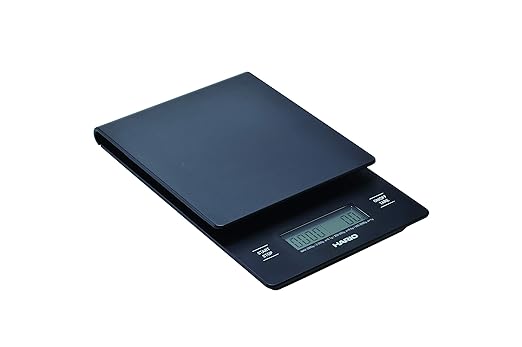
Hario V60 Drip Scale
A coffee scale with a built-in timer is the one tool that makes ratio brewing practical. The Hario V60 scale reads to 0.1 g precision, has a dedicated pour-over timer button, and auto-starts when it detects the weight of a vessel. Compact enough to stay on the counter permanently.
- 0.1 g precision — catches measurement variance scoops miss
- Built-in timer with auto-start — no phone juggling during pour
- Works for drip, pour over, French press, and AeroPress
Why Grams Beat Scoops
A standard coffee scoop holds approximately 10 grams — but “approximately” is doing heavy lifting here. The same scoop holds 8.5 grams of a lightly roasted light-density bean and 11.5 grams of a dense dark roast. Pack it slightly versus level it and you swing by another 1–2 grams. Over 4 scoops for a morning pot, that’s a variance of 10–15 grams — equivalent to one full extra scoop worth of inconsistency.
Grams on a scale eliminate that variable entirely. You’re measuring mass, not volume. Grind size, roast level, and how the bag was stored become irrelevant to your dose accuracy.
The other advantage: you can dial a recipe in once and repeat it exactly every time. That’s how you stop chasing a “good cup” and start making one reliably.
Quick Reference Chart
| Brewing Method | Ratio | Coffee (per 1 cup / 237 ml) | Water (per 1 cup) |
|---|---|---|---|
| Drip Coffee Maker | 1:16 – 1:17 | 14–15 g | 237 ml |
| Pour Over (V60, Chemex) | 1:15 – 1:16 | 15–16 g | 237 ml |
| French Press | 1:14 – 1:15 | 16–17 g | 237 ml |
| AeroPress (full cup) | 1:14 – 1:16 | 15–17 g | 237 ml |
| Cold Brew (concentrate) | 1:5 – 1:8 | 30–50 g | 237 ml |
| Espresso (double shot) | 1:2 – 1:2.5 | 18–20 g (in) | 36–50 ml (out) |

What to Adjust When It Tastes Off
The golden ratio gets you into the right neighborhood. Fine-tuning happens by adjusting one variable at a time:
- Coffee tastes weak / thin: Increase dose by 1–2 grams (move ratio toward 1:15). Don’t increase brew time or reduce water — that changes extraction, not concentration.
- Coffee tastes too strong / heavy: Reduce dose by 1–2 grams (move ratio toward 1:17), or use slightly more water.
- Coffee tastes bitter despite correct ratio: The issue is extraction, not ratio — see our guide on why coffee tastes bitter. Water too hot, grind too fine, or brew time too long are the usual causes.
- Coffee tastes sour or underextracted: Grind finer, use hotter water, or increase brew time slightly.
Always change one variable between brews. Changing ratio and grind size simultaneously makes it impossible to know which change made the difference.
Frequently Asked Questions
How many tablespoons of coffee per cup?
The common guideline is 1 to 2 tablespoons per 6 oz of water — which translates roughly to 1 tablespoon per 8 oz if you prefer lighter coffee, or 2 tablespoons if you want it stronger. In weight terms, 1 level tablespoon is approximately 5–7 grams of ground coffee. For a standard 8 oz cup using the 1:16 ratio, you need around 15 grams, which is about 2 level tablespoons. Measuring by weight is significantly more accurate.
Does the ratio change for dark roast vs light roast?
Slightly. Dark roast beans are less dense because the roasting process drives out moisture and CO₂ — the same volume of grounds weighs less. If you’re measuring by volume (scoops), you get fewer grams with dark roast than light, which means the cup may taste weaker. If you’re measuring by weight, the ratio stays the same but you may want to lean toward 1:15 for dark roasts, which tend to extract faster and can taste hollow if brewed too light. Light roasts often benefit from a slightly longer brew or finer grind rather than more coffee.
How much coffee for a 12-cup coffee maker?
A “12-cup” pot usually holds about 60 oz (1,775 ml) of water — manufacturers define a “cup” as 5 oz rather than 8 oz. Using the 1:16 ratio, that’s approximately 110 grams of coffee, or roughly 12–14 level tablespoons. Most drip machine carafes have measurement lines — fill to the 12-cup line and dose accordingly. If your machine’s coffee tastes consistently weak at this ratio, check the brew temperature: machines that don’t reach 195–205°F will under-extract regardless of dose.
Do I need an expensive scale to measure coffee by weight?
No. Any kitchen scale that reads to 1-gram precision is sufficient for drip and French press brewing. A 0.1-gram precision scale (like the Hario V60) is useful for pour over recipes where small variances matter more. Entry-level food scales in the $10–15 range work fine for most home brewing purposes. The consistency gain from measuring by weight at any precision level far outweighs the cost of the tool.
Why does my coffee still taste off even with the correct ratio?
Ratio controls concentration, not extraction quality. A correct 1:16 ratio can still produce bitter or sour coffee if water temperature is wrong (too hot = bitter, too cool = sour), grind size is off, brew time is too long or short, or equipment is dirty. The golden ratio is the starting point, not the complete solution. Once you’ve nailed the ratio, the next variables to dial are water temperature (target 195–205°F / 90–96°C) and grind size.