
Best Coffee Grinders 2026 — Burr vs Blade (What Actually Matters)
A blade grinder chops coffee randomly — producing a mix of powder and chunks that extract at different rates, guaranteeing an inconsistent cup. A burr grinder crushes beans between two abrasive surfaces to a uniform size. This difference is the single biggest upgrade available to home coffee drinkers.
🔗 This page contains affiliate links. As an Amazon Associate, HotKitch earns from qualifying purchases — at no extra cost to you.
Burr vs Blade — The Only Comparison That Matters
A blade grinder works like a blender — spinning metal blades chop the beans at random. Grind time determines coarseness, but the result is always uneven: some particles are fine powder, others are chunky fragments. When these mixed particles hit hot water, the fine powder extracts immediately (producing bitterness) while the large chunks under-extract (producing sourness). You get both at once, which is why blade-ground coffee tastes muddled regardless of the beans.
A burr grinder uses two abrasive surfaces — conical or flat — set at a specific distance apart. Every bean passes through the same gap and comes out the same size. Uniform particles extract at the same rate, which means your brewing variables (water temperature, time, ratio) actually predict the outcome instead of fighting inconsistency.
The upgrade from blade to burr grinder is larger than upgrading from cheap beans to expensive beans. You can spend $50 on a burr grinder and $8 on medium-roast beans and outperform $30 beans ground in a blade grinder every time.
Conical vs Flat Burr Grinders
Within burr grinders, two designs exist:
- Conical burr: One cone-shaped burr rotates inside a fixed outer ring. Produces slightly less heat during grinding, quieter operation, and works at lower RPM — which means less static and easier cleaning. The standard for home grinders at most price points. The Baratza Encore uses conical burrs.
- Flat burr: Two horizontal disc-shaped burrs face each other. Generally more consistent particle distribution at the expensive end of the market, but the difference is minimal at home brewing volumes. Found in high-end espresso grinders. Not necessary for home drip or pour over.
For home use, conical burr is the correct choice at every budget below $300. The flat burr advantage only manifests at espresso brewing precision levels.
Best Grinders by Budget
Best Budget Burr Grinder — Hario Mini Slim Pro (~$45)
A hand grinder — manual operation, no motor. Takes 60–90 seconds of hand cranking per dose, which is actually fine for 1–2 cups in a pour-over or AeroPress routine. Ceramic conical burrs, adjustable grind size, compact for travel. The grind consistency exceeds electric grinders at twice the price. The correct choice if you make 1–2 cups per day and don’t mind the effort.

Hario Mini Slim Pro Hand Grinder
Ceramic conical burrs, adjustable grind, compact enough for travel. Produces grind consistency that rivals electric grinders at twice the price — for pour over, AeroPress, or French press doses. No electricity, no static. The correct first burr grinder for single-cup brewing.
- Ceramic burrs — rust-proof, heat-resistant, lasts years
- Compact and travel-ready — fits in a bag or backpack
- No static — grounds fall cleanly without clinging
Best Mid-Range Electric — Baratza Encore (~$170)
The reference entry-level electric burr grinder. 40 grind settings covering the full range from espresso to French press, conical steel burrs, and a design built to be repaired — Baratza sells every individual component separately. It grinds consistently, doesn’t heat the beans noticeably, and produces minimal static. Most importantly, when it eventually needs maintenance (after years of daily use), you buy a $15 part rather than a new grinder. The Encore has been the home coffee standard for a decade for this reason.

Baratza Encore Burr Grinder
40 grind settings, conical steel burrs, and a repairable design that Baratza backs with individual spare parts. Covers drip, pour over, French press, and AeroPress with consistent results. The benchmark home grinder at this price — still the correct answer after a decade of competition.
- 40 grind settings — covers every brew method
- Repairable design — buy parts, not a new grinder
- Conical steel burrs — consistent grind at every setting
Best Mid-Range Alternative — OXO Brew Conical Burr Grinder (~$100)
If the Baratza Encore is over budget, the OXO Brew is the best $100 electric burr grinder available. 15 grind settings (fewer than the Encore, but enough for most home brewers), a built-in timer for automatic shutoff, and a design that minimizes static noticeably better than the Encore. The grind consistency is slightly below the Encore’s but meaningfully above any blade grinder.
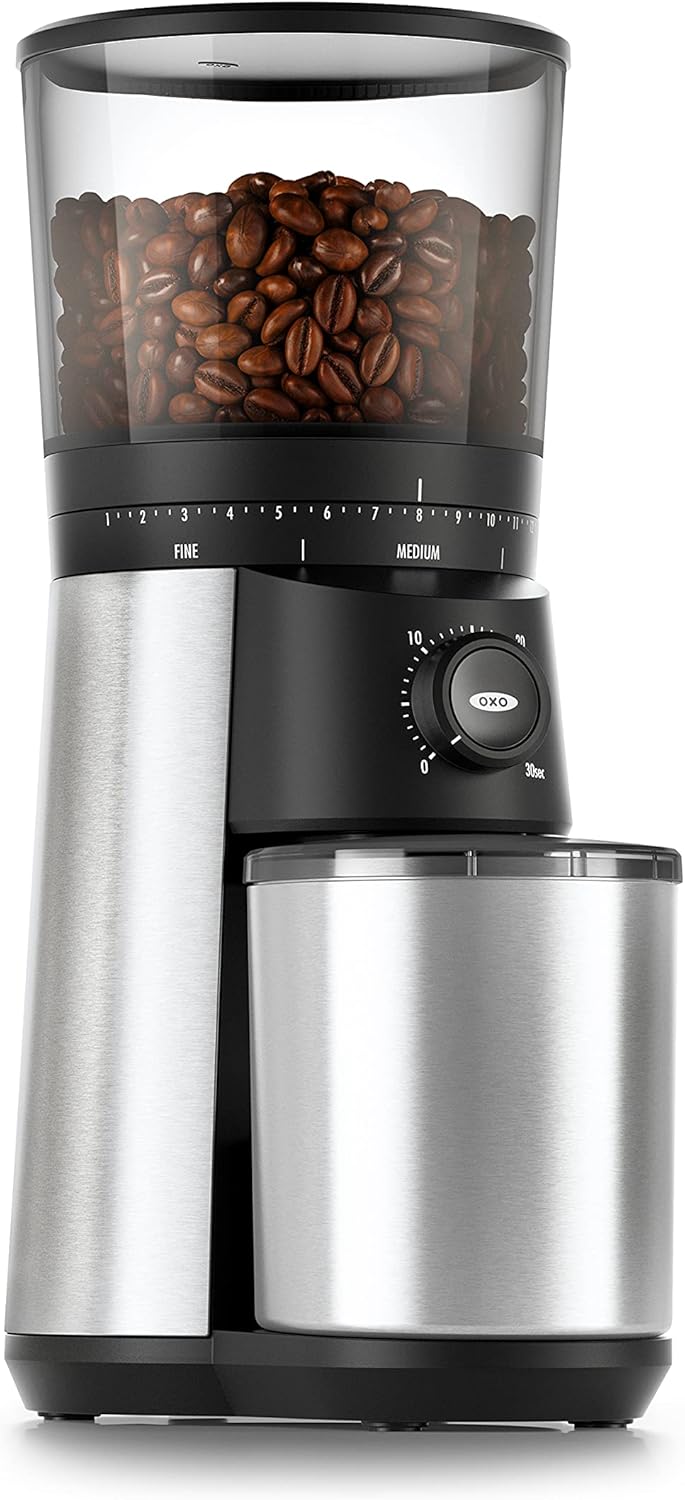
OXO Brew Conical Burr Grinder
15 grind settings, built-in timer, one-touch operation, and a design that minimizes static. The best electric burr grinder under $100 for home drip and pour-over brewing. A meaningful upgrade over any blade grinder at roughly twice the price.
- Built-in timer — grinds the same dose consistently every time
- Minimal static design — grounds fall cleanly into the container
- One-touch operation — no manual settings adjustment needed

What to Avoid
- Blade grinders sold as “coffee grinders”. Any grinder under $20 that shows spinning blades in the product photos is a blade grinder. The KitchenAid BCG111OB, the classic Mr. Coffee blade grinder — avoid these regardless of reviews.
- Combo grinder/coffee makers. Machines with built-in grinders sacrifice grind quality to save counter space. The grinders in these units are almost always under-engineered blade or poor-quality burr systems.
- Grinders with fewer than 10 grind settings. If you can only dial between 5 settings, you can’t fine-tune when your brew tastes off.
Frequently Asked Questions
Can a burr grinder grind for espresso?
Entry-level burr grinders like the Baratza Encore can grind fine enough for espresso, but the grind adjustment isn’t precise enough for consistent espresso dialing. Espresso requires adjustment in tiny increments — a setting change that shifts extraction by 2–3 seconds. The Encore’s steps are too large for this. For espresso, a dedicated espresso grinder (Baratza Sette 270, DF64) is a better investment. For drip, pour over, AeroPress, and French press, the Encore is the correct choice.
How often should I clean my coffee grinder?
For daily home use, a light cleaning every 1–2 weeks and a thorough cleaning monthly is sufficient. Light cleaning: brush out the grounds chamber and hopper with the included brush or a soft pastry brush. Thorough cleaning: disassemble the burrs (refer to your manual) and clean with a dry brush — no water on steel burrs. Grinder cleaning tablets (Urnex Grindz) run a quick cleaning cycle without disassembly and work well between manual cleans. Old coffee oil buildup causes rancid flavors over time — the monthly clean prevents this.
Is an expensive grinder worth it if I use pre-ground coffee?
No. Pre-ground coffee has already lost a significant portion of its volatile aromatics by the time you buy it — the grind quality of your brewer equipment can’t recover that. If you’re using pre-ground, focus the budget on better beans or a better coffee maker. A burr grinder only adds value when you’re grinding whole beans immediately before brewing — which is the workflow it’s designed to support.