
How to Choose a Chef’s Knife:
Steel Types, Edge Angles & What Actually Matters
A $40 knife with the right geometry will outcut a $200 knife with the wrong one. Steel hardness, edge angles, German vs. Japanese — and the three mistakes that cost home cooks money.
Most home cooks own a dull, uncomfortable knife they grabbed off an Amazon lightning deal — and they compensate by pressing harder, sawing back and forth, and quietly accepting that onions will always make them cry. The knife isn’t the problem. The wrong knife is the problem.
I’ve tested dozens of chef’s knives over the past three years at HotKitch. The single biggest lesson: a $40 knife with the right steel and geometry will outcut a $200 knife with the wrong ones. The marketing around “German precision” and “Japanese mastery” is thick, and most of it is designed to justify price tags — not improve your cooking.
This guide covers what actually separates a good knife from a bad one. No brand worship, no spec-sheet theater. Just the factors that affect how a knife performs in your hand, on your cutting board, five nights a week.
Steel Types: What the Rockwell Number Actually Tells You
Every knife brand throws around steel names like they’re casting spells — X50CrMoV15, VG-10, AUS-10, 440C. Here’s what matters: the Rockwell Hardness Scale (HRC) tells you how hard the blade is, and hardness dictates almost everything about how the knife behaves.
56–58 HRC — German-Style (X50CrMoV15)
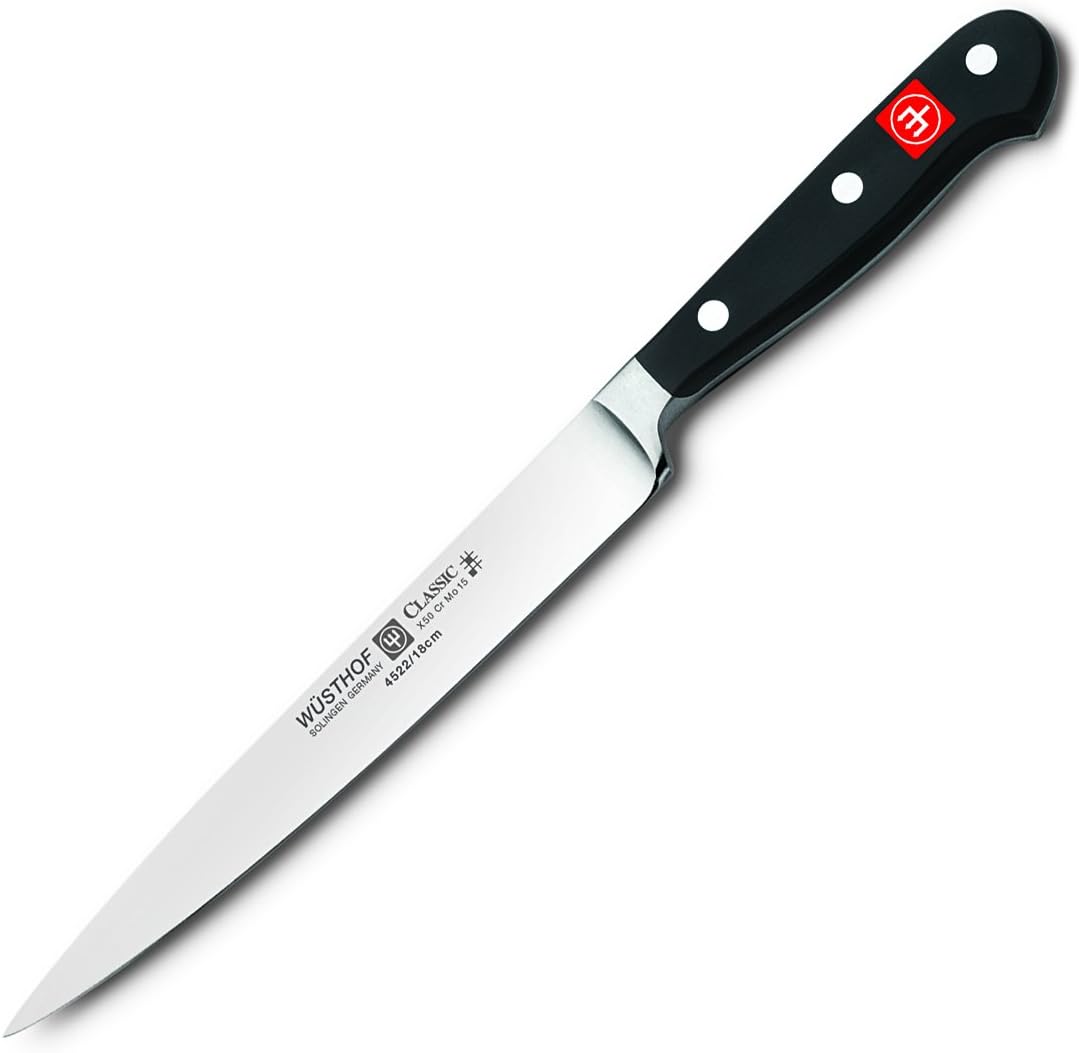
Wüsthof, Henckels, and most Western knives sit here. Softer steel flexes before it chips — you can rock-chop aggressively, nick a chicken bone, or toss the knife in a sink full of dishes without cracking the edge. Trade-off: the edge dulls faster. Hone every 2–3 cooking sessions, sharpen properly every 3–6 months.
X50CrMoV15 is a workhorse alloy: stain-resistant, easy to sharpen at home with a pull-through or honing rod, and forgiving of technique mistakes. If you’re honest about never sharpening your knives, this is your steel.
60–62 HRC — Japanese-Style (VG-10, AUS-10)
Shun, Miyabi, Global, and most gyutos land here. Harder steel holds a sharper edge for longer — in our chef’s knife testing, we measured roughly 2–3× the edge retention compared to German knives at the same price. The trade-off: brittle. A lateral twist while prying apart a butternut squash can chip the edge. These knives demand straight-down cuts, no torquing, no frozen food, and careful hand-washing.
VG-10 is the Honda Civic of Japanese knife steel — reliable, well-understood, everywhere. Damascus-patterned blades are decorative layers over a VG-10 core. They look stunning but don’t change cutting performance.
Carbon Steel — No “Stainless”
Carbon steel (0.83%+ carbon, no chromium buffer) is what pro kitchens used before stainless became standard. It takes an edge that feels almost unfair compared to stainless. The catch: it reacts with acidic food (tomatoes, citrus, onions), builds a patina, and will rust if stored wet even briefly.
If you’ll wash and dry immediately every time and enjoy the ritual of seasoning a knife the way you season cast iron, carbon steel rewards the effort. If knives sit in your sink, skip it entirely.
Below 56 HRC — Budget Steel (3Cr13, 420-series)
Knives under $25 typically use these alloys. They’re soft, dull fast, and sharpen poorly because the steel can’t hold a refined edge. No amount of honing fixes soft steel — the material itself is the ceiling. The Victorinox Fibrox Pro at ~$40 uses proprietary steel at 56 HRC that arrives sharper out of the box than many knives costing three times as much. It’s the correct exit from this tier.
| Property | German (X50CrMoV15) | Japanese (VG-10) | Budget (3Cr13) |
|---|---|---|---|
| Hardness (HRC) | 56–58 | 60–62 | 50–54 |
| Edge retention | Moderate | High | Low |
| Chip resistance | Excellent | Low–moderate | Excellent |
| Sharpen at home | Easy (pull-through OK) | Whetstone preferred | Easy but won’t hold |
| Stain resistance | High | Moderate–high | High |
| Typical price (8″) | $100–$180 | $120–$250 | $10–$25 |
📖 Already know what you want?
We tested 5 chef’s knives across 8 weeks of daily use — edge retention, handle comfort, balance, and real food prep. → Best Chef’s Knives 2026 — Full Test Results
Edge Angles: The 15° vs. 20° Decision
If steel is the engine, edge angle is the tires. Two knives made from identical steel will perform completely differently depending on how the edge is ground. A lower angle creates a thinner, sharper cutting edge. A higher angle creates a thicker, more durable one.
20° Per Side — German Standard
The default for Wüsthof, Henckels, and most Western knives. At 40° total inclusive, the edge handles hard vegetables, bone-adjacent cutting, and imperfect technique. It won’t glide through a ripe tomato like a laser — but it won’t chip when you twist into a sweet potato, either. For home cooks who chop 4–5 nights a week and sharpen once or twice a year, 20° is the practical choice.
15° Per Side — Japanese Standard
Japanese knives at 30° inclusive feel noticeably sharper. Paper-thin tomato slices, effortless herb chiffonade, zero-resistance through an onion. The edge is roughly 25% thinner than a 20° edge. In our testing, a 15° edge on VG-10 chipped visibly after lateral contact with a chicken bone at moderate force. The same scenario on a 20° German edge left no visible damage. If you work around bones, use frozen ingredients, or occasionally use your chef’s knife as a pry bar — 15° will punish you.
17–18° — The Hybrid Range
The overlooked middle option. Some Western-Japanese hybrid knives ship at 17°. You get the sharpness improvement over 20° German edges while staying meaningfully tougher than a 15° Japanese edge. If you own a whetstone and use it occasionally, this is the sweet spot most buyers never look for.
| Angle (per side) | Sharpness | Chip resistance | Best for | Maintain with |
|---|---|---|---|---|
| 15° (Japanese) | 🔪🔪🔪🔪🔪 Razor | ⚠️ Low | Slicing, herbs, fish, fine work | Whetstone (1000/3000 grit) |
| 17–18° (Hybrid) | 🔪🔪🔪🔪 Very sharp | ✅ Good | All-purpose, serious home cook | Whetstone or guided system |
| 20° (German) | 🔪🔪🔪 Sharp | ✅✅ Excellent | Chopping, root veg, poultry breakdown | Any sharpener, pull-through OK |

Handle, Balance & the One Test Worth Doing
Handle Fit
A handle that’s too thick or shaped wrong for your grip causes fatigue and blisters after 10 minutes of continuous prep. German knives typically have heavier, full-tang handles with a pronounced bolster. Japanese knives favor lighter, thinner handles — often octagonal wood or resin. There’s no objectively better handle. There’s only the one that fits your hand. If buying online, research handle circumference and total weight. A 200g knife feels completely different from a 280g knife over a 30-minute prep session.
Balance and the Pinch Grip Test
Hold the knife in a pinch grip — thumb and index finger pinching the blade just above the bolster, remaining fingers wrapped around the handle. Let your wrist go relaxed. If the tip dips heavily forward, the knife is blade-heavy — useful for chopping, tiring for long prep. If the handle pulls back, it’s handle-heavy — good for precision, awkward for power cuts. Neutral balance, where the knife stays level without effort, works for everything.
Most quality knives in the $80–$160 range are engineered for neutral balance. Cheap knives rarely are.
Thickness Behind the Edge
This is the variable almost no buying guide mentions. Run a finger along the flat of the blade near the edge — a knife that feels noticeably tapered and thin will slice with less resistance than a thick one, regardless of how sharp both are. The Victorinox Fibrox is thin. Many “premium” knives with beautiful finishes are thick wedges that split food rather than slice it. Geometry cuts — steel type is secondary.
Blade Length
The 8-inch chef’s knife is the default recommendation because it handles nearly every home cooking task. Smaller hands, limited cutting board space, or a kitchen where you mostly prep vegetables — a 7-inch blade might be more comfortable. If you regularly break down large cuts of meat, a 10-inch saves time. Don’t buy a size because someone told you to. Buy the one that matches what you actually cut.
The Three Mistakes That Cost Home Cooks Money
1. Buying a Knife Set Instead of One Good Knife
A 15-piece block set for $150 gives you 15 mediocre knives made from bargain steel. The same $150 buys one excellent chef’s knife, a $12 paring knife, and a $20 bread knife — covering 95% of kitchen tasks with dramatically better performance. One great knife beats ten mediocre ones every single time.
2. Choosing Looks Over Geometry
Damascus patterns, hammered finishes (tsuchime), and colorful resin handles sell knives. None of them cut food. A plain knife with thin blade geometry and good steel will outperform a gorgeous knife with a thick, wedge-like cross-section. When a knife splits an onion apart instead of slicing through it — that’s a geometry problem. No amount of hammered texture fixes it.
3. Ignoring the Cutting Board
A hard cutting surface — glass, marble, ceramic — destroys knife edges faster than any food does. A quality wood or plastic cutting board is not an accessory. It’s part of the knife system. If you’re using a glass board, you’re resharpening every month instead of every six. That’s not a knife problem — that’s a board problem.
Maintenance: The Part That Decides Everything
The best knife in the drawer is the sharpest knife in the drawer. A $200 knife untouched for six months loses to a $60 knife touched up last week. Maintenance is the real differentiator at home — not the steel, not the brand.
- Hone weekly (if you cook 5+ nights). A honing rod realigns the edge without removing metal. 10 seconds. German steel responds to a grooved rod; Japanese steel prefers a smooth ceramic or leather strop.
- Sharpen 2–3 times a year for a daily-use knife. Pull-through sharpeners work fine on German steel. For Japanese knives, use a whetstone (1000 grit for dull, 3000 for maintenance) or pay for professional sharpening — a pull-through will damage the thinner edge.
- Never put it in the dishwasher. The heat warps handles, the detergent pits the steel, and rattling dulls the edge against other utensils. Every knife, every price point.
- Store on a magnetic strip or in a blade sheath, not loose in a drawer where the edge contacts other metal.
Quick Decision Matrix
| Your situation | Recommended style | Budget | Example |
|---|---|---|---|
| First serious knife, learning technique | German, 20°, 8-inch | $40–$60 | Victorinox Fibrox Pro |
| Confident home cook, 5+ nights/week | German or hybrid, 17–20°, 8-inch | $100–$160 | Wüsthof Classic 8″ |
| Precision-focused, owns a whetstone | Japanese, 15°, 8-inch gyuto | $120–$200 | MAC MTH-80 or Tamahagane San Tsubame |
| Wants maximum sharpness, mostly slicing & fine work | Japanese, 63 HRC, thin grind | $180–$250 | Tamahagane San Tsubame |
| Loves patina, washes immediately after use | Carbon steel (no stainless) | $80–$180 | Togiharu Carbon Gyuto |
| Small hands or limited counter space | Any style, 7-inch | Varies | Wüsthof Classic 7″ or Fujitora FU-808 |
The Bottom Line
A chef’s knife is the one tool you’ll hold more than any other in your kitchen. The right choice comes down to three honest questions: How hard are you willing to maintain it? How do you actually grip and cut? And what are you cutting most nights?
If you answered “not much,” “however feels natural,” and “vegetables and chicken” — an 8-inch German knife in the $100–$150 range will serve you for a decade. If you sharpen regularly and value precision above all else, a Japanese gyuto at 15° will feel like an upgrade you can’t go back from.
- Under $60: Victorinox Fibrox Pro 8″ — thin, properly ground, genuinely better than most knives at twice the price.
- $100–$160: Wüsthof Classic 7″ for German durability — 20°, forgiving, sharpenable with any tool. Built to last 15 years of daily use.
- Best all-around: MAC Professional MTH-80 — 60 HRC, 17° hybrid edge, hollow-ground dimples. The knife most serious testers end up recommending. Outperforms its price class in every metric except handle finish.
- Best Japanese: Tamahagane San Tsubame — 63 HRC SRS-15 steel, exceptionally thin grind, the knife we reach for when precision matters more than durability.
Full breakdown, including edge retention data after 8 weeks of daily use, in our Best Chef’s Knives 2026 — incl. Wüsthof, Victorinox & Tamahagane guide.
Frequently Asked Questions
What is the best steel for a chef’s knife?
For most home cooks, high-carbon stainless steel hits the right balance. German X50CrMoV15 (56–58 HRC) is forgiving, easy to sharpen at home, and resists chipping. Japanese VG-10 or AUS-10 (60–62 HRC) holds a sharper edge longer but needs a whetstone and careful use. Pure carbon steel is sharper than both but rusts if left wet.
Should I choose a 15-degree or 20-degree edge angle?
A 15° edge (Japanese) is sharper and slices more effortlessly but chips on hard food and needs whetstone maintenance. A 20° edge (German) is more durable and sharpenable with basic tools. A 17–18° hybrid is the best of both if you use a whetstone occasionally. Match the angle to your maintenance habits.
How much should I spend on a chef’s knife?
$40–$160 covers every skill level. The Victorinox Fibrox Pro (~$40) outperforms most knives under $100. The Wüsthof Classic ($120–$160) is a 15-year investment. Above $200, you’re mostly paying for craftsmanship and aesthetics, not kitchen performance.
German knife vs Japanese knife — which should I get?
German knives are heavier, 56–58 HRC, 20° edge — workhorses you can sharpen with a pull-through and abuse moderately. Japanese knives are lighter, 60–62 HRC, 15° edge — sharper and longer-lasting, but require a whetstone and careful use around bones. Match the knife to your maintenance habits, not your ambitions.
How often should I sharpen a chef’s knife?
Hone weekly (realigns the edge, no metal removed, 10 seconds). Sharpen — actual metal removal — 2–3 times a year for a daily-use knife. A knife honed consistently will need sharpening far less often than one that’s been ignored. The maintenance habit matters more than the steel grade.
What is the difference between forged and stamped knives?
Forged knives are made from a single piece of steel — typically heavier with a bolster. Stamped knives are cut from sheet steel — lighter and thinner. Quality matters more than method: the Victorinox Fibrox is stamped and outcuts many forged knives at twice the price. Don’t use forged/stamped as a quality signal.
Ready to pick your knife?
We tested 5 chef’s knives across 8 weeks of daily use — edge retention, handle comfort, balance, and real food prep.
View Best Chef’s Knives 2026 →Related: Best Cutting Boards 2026 · How to Choose a Stove · Best Chef’s Knives 2026 — incl. Wüsthof, Victorinox & Tamahagane
Affiliate disclosure: Some links on this page are affiliate links. We earn a small commission if you buy — at no extra cost to you. Editorial content is independent of affiliate relationships. Full disclosure →