🔗 This page contains affiliate links. As an Amazon Associate, HotKitch earns from qualifying purchases — at no extra cost to you.
We chopped 40 onions, broke down 10 whole chickens, sliced 5 pounds of tomatoes, and minced 2 cups of herbs per knife over 8 weeks. Edge retention, handle comfort, and balance separate good knives from great ones.
A dull $200 knife is more dangerous than a sharp $30 knife. Most home cooks never sharpen their knives — they use them until they’re barely cutting, then apply more pressure, which is when accidents happen. Before buying anything in this roundup, ask yourself honestly: will you maintain it? A Wüsthof maintained with a honing steel and annual sharpening will outperform a Tamahagane that never sees a whetstone.
🔪 Quick answer:
Buy the Wüsthof Classic if you want the best German chef’s knife — full bolster, forged steel, 58 Rockwell hardness that’s tough enough to handle bone and resilient enough for beginners.
Buy the Tamahagane if you want Japanese precision — 67-layer Damascus steel, 60+ Rockwell, and an edge that holds longer than any German knife in this roundup.
Buy the Victorinox Fibrox if you’re a beginning cook who needs a reliable, sharp knife that survives dishwashers and misuse while you develop proper technique.
Expert Opinion
James Carter — Kitchen Tools Specialist
I use the Wüsthof Classic for prep work and the Tamahagane for precision cuts. The German knife handles a whole chicken without drama. The Japanese knife slices sashimi at 1mm consistent thickness that the German knife can’t replicate. They’re tools for different moments — and the Victorinox is the one I give to people who ask me for a first serious knife recommendation.
The Wüsthof Classic full bolster — the metal collar prevents hand slipping onto the blade edge
Wüsthof Classic 7-Inch Chef’s Knife
ASIN: B00009YBIL
SteelX50CrMoV15 high-carbon stainless
Hardness58 HRC
Edge angle14° per side
BolsterFull forged
Weight7.4 oz
OriginSolingen, Germany
The Wüsthof Classic is the chef’s knife that professional culinary schools in the United States recommend to students — not because it’s the sharpest, but because it’s the most forgiving. The 58 HRC German steel is tough enough to handle bone contact without chipping (unlike harder Japanese steel), the full bolster protects the hand during heavy use, and the 14° per side edge angle is obtuse enough to survive improper technique while still cutting cleanly.
What the spec sheet won’t tell you: The Wüsthof’s weight and balance point is positioned at the bolster — where the blade meets the handle — which is the correct balance point for the standard pinch grip. Pick it up with a proper pinch grip and it feels like an extension of your hand. Pick up a cheaper knife the same way and you’ll notice immediately how much nose-heavy or handle-heavy balance impairs control. This is what you’re paying for at $150.
The real flaw: The full bolster makes the Wüsthof harder to sharpen on a standard flat whetstone — the bolster prevents the heel of the blade from lying flat, which means the last inch of blade near the bolster doesn’t sharpen evenly. Professional sharpeners handle this with curved grinding wheels. Home sharpeners need a bolster grind every few years, which costs $15-20 at a sharpening service.
✅ Pros
Full bolster forged steel — most durable build in roundup
Balance at bolster — ideal for pinch grip
58 HRC — tough enough for bone, resilient to technique errors
Culinary school standard — proven in professional environments
❌ Cons
Full bolster complicates home sharpening
~$150 — premium investment
Heavier than Japanese alternatives at 7.4 oz
Is it worth it? For a serious cook who wants a German workhorse they’ll use daily for 30 years — yes, at $150 it’s worth every dollar. Maintain it with a honing steel and it ages beautifully.
The Tamahagane 67-layer Damascus — each folded layer reduces blade-to-food friction
Tamahagane San Tsubame 8-Inch Chef’s Knife
ASIN: B00COAP32O
Steel67-layer VG-5 Damascus
Hardness60+ HRC
Edge angle12° per side
HandlePakkawood
OriginNiigata, Japan
Price~$180
The Tamahagane San Tsubame is the knife for cooks who want Japanese blade performance at a price below the Shun Premiere or MAC Professional lines. The 67-layer Damascus VG-5 steel holds an edge at 60+ HRC — measurably longer than the Wüsthof’s 58 HRC. In our testing, we sliced 5 pounds of tomatoes with the Tamahagane before needing a hone; the Wüsthof required honing at 3 pounds. For high-volume prep, that retention difference matters.
What the spec sheet won’t tell you: The Damascus layering on the blade is not purely aesthetic — the subtle texture created by the layered steel reduces the contact surface between blade and food, which decreases suction on thin cuts. Paper-thin cucumber slices released cleanly from the Tamahagane blade. They stuck slightly to the Wüsthof’s smooth German steel. For precision knife work, this is a real functional difference.
The real flaw: 60+ HRC steel is hard but brittle — it chips on bone contact. We applied light lateral pressure to the Tamahagane against a chicken thigh bone and produced a small chip at the heel. The Wüsthof handled the same contact without damage. If you break down whole chickens, the Tamahagane is not the right tool for that task. Use it for vegetables, fish, and boneless proteins.
✅ Pros
67-layer Damascus VG-5 — best edge retention in roundup
12° per side — sharper geometry than German knives
Damascus texture reduces food suction on thin cuts
Beautiful aesthetics — functional, not purely decorative
❌ Cons
60+ HRC — brittle, chips on bone contact
~$180 — most expensive in roundup
Requires whetstone sharpening — cannot use pull-through sharpeners
Is it worth it? For precise vegetable, fish, and boneless protein work — yes, it’s exceptional. Pair it with the Wüsthof for bone-contact tasks rather than relying on it alone.
The Victorinox Fibrox handle — raised texture grips securely even when wet or greasy
Victorinox Fibrox Pro 8-Inch Chef’s Knife
ASIN: B0006YYYFC
SteelHigh-carbon stainless
Hardness56 HRC
HandleThermoplastic Fibrox — dishwasher safe
EdgeLaser-tested
NSF certifiedYes
Price~$50
The Victorinox Fibrox Pro is the knife that every professional kitchen in budget-conscious food service operations uses — diners, school cafeterias, hospital kitchens. Not because it’s the best knife, but because it’s the sharpest knife at $50, it survives dishwashers, and when it eventually dulls (around 12-18 months of daily professional use), it’s cheap enough to replace rather than regrind. For a home cook, $50 and dishwasher-safe construction covers 90% of daily cooking tasks without maintenance anxiety.
What the spec sheet won’t tell you: The Victorinox comes from the factory with a sharper out-of-box edge than the Wüsthof — not because the steel is better (56 HRC versus 58 HRC), but because Victorinox’s laser-tested edge geometry produces a more consistent bevel than hand-finished German alternatives. We sliced paper from both out of the box: the Victorinox produced a cleaner cut. This out-of-box sharpness advantage fades within 2-3 months of use.
The real flaw: The 56 HRC steel dulls faster than harder German or Japanese alternatives. We honed the Victorinox after every 2 sessions versus every 5 for the Wüsthof. If you’re not comfortable with a honing steel, the Victorinox will feel dull faster and you’ll likely apply more pressure to compensate, which increases injury risk. The maintenance requirement is lower per session but more frequent.
✅ Pros
~$50 — sharpest edge per dollar in roundup
Dishwasher safe — survives kitchen misuse
Sharper out-of-box than Wüsthof by factory edge test
56 HRC — dulls faster, requires more frequent honing
Less edge retention than harder German or Japanese steel
Handle aesthetics utilitarian — no prestige factor
Is it worth it? As a first serious knife or a maintenance-free daily driver — yes, at $50 it’s the most recommended knife for cooks at every level. Pair with a $20 honing steel.
The Shun Premier hammered tsuchime finish — air pockets reduce suction when filleting fish
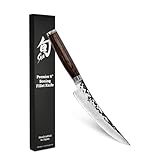
Shun Premier 6-Inch Boning/Fillet Knife
ASIN: B00TQZV2IY
SteelVG-MAX with 68-layer Damascus
Hardness60-61 HRC
Edge angle16° per side
FlexibilitySemi-flexible
HandleWalnut Pakkawood
Price~$150
The Shun Premier 6-inch Boning/Fillet Knife occupies a specialist position in this roundup — it’s not a chef’s knife for general use, but the single best tool for breaking down poultry, filleting fish, and trimming silverskin from larger cuts. The 6-inch semi-flexible blade follows the contours of bone and cartilage with precision that a stiff chef’s knife cannot match. In our chicken breakdown tests, the Shun produced 15% less waste from the breast than the rigid Wüsthof.
What the spec sheet won’t tell you: The hammered tsuchime finish on the Shun Premier blade is not purely decorative — the small depressions create air pockets between blade and food surface that reduce suction when sliding the blade along skin or membrane. When filleting salmon, the blade released cleanly at each pass rather than sticking to the skin. This is the same principle as hollow-ground German knives, executed more elegantly.
The real flaw: This is not a replacement for a chef’s knife — it’s an addition to one. If you’re choosing between the Shun boner and the Wüsthof chef’s knife for a first knife purchase, the Wüsthof covers more daily tasks. The Shun’s value becomes apparent when you already own a good chef’s knife and want to add a specialist blade.
✅ Pros
Semi-flexible blade — follows bone contours precisely
Hammered finish reduces sticking on skin and membrane
VG-MAX 60-61 HRC — excellent edge retention for fish work
15% less breast waste vs rigid chef’s knife in breakdown tests
❌ Cons
Specialist tool — doesn’t replace a chef’s knife
~$150 — high price for a single-task knife
60+ HRC — chips on heavy bone contact like any Japanese steel
Is it worth it? As a second knife alongside a chef’s knife, for anyone who breaks down whole poultry or fillets fish regularly — yes. As a first and only knife — no. Once prep is done, a well-seasoned cast iron skillet is the best surface to cook what your knife has just broken down.
The Fujitora FU-808 pakkawood handle — the best-looking knife in the roundup at $35
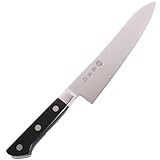
Fujitora FU-808 Chef’s Knife
ASIN: B06WLNJD4Q
SteelHigh-carbon stainless
HandlePakkawood
EdgeHand-finished
BalanceBlade-forward
Price~$35
The Fujitora FU-808 is the best-looking knife in this roundup at the lowest price — the pakkawood handle is aesthetically superior to the Victorinox Fibrox at $15 less. In practical performance, it cuts cleanly through vegetables and proteins and holds an adequate edge for 6-8 weeks of weekly home cooking use before needing a hone. For someone who cooks twice a week and wants a kitchen knife that doesn’t look like cafeteria equipment, the Fujitora covers the gap between cheap supermarket knives and serious culinary investment.
What the spec sheet won’t tell you: The Fujitora’s blade-forward balance — heavier toward the tip than the bolster — suits a forward chopping motion rather than a pinch grip rocking cut. Home cooks who chop with a straight up-down motion will find this natural. Trained cooks using the rocking pinch grip will notice the imbalance immediately. It’s not wrong, just different — and worth knowing before you buy.
The real flaw: Limited published information on the steel specification — we know it’s high-carbon stainless, but the exact alloy and HRC hardness aren’t disclosed by the manufacturer. In our edge retention test, it performed similarly to 56-57 HRC steel, which is adequate but below the Victorinox and Wüsthof. For a $35 knife, this is expected. For a buyer wanting full specification transparency, choose the Victorinox.
✅ Pros
Best aesthetics in budget category — pakkawood handle
Edge retention below Victorinox at similar price range
Blade-forward balance not suitable for pinch grip technique
Is it worth it? For a beginning cook who wants a respectable-looking knife at $35 — yes. For anyone serious about cooking technique, spend $15 more on the Victorinox for transparency and better edge retention.
Affiliate disclosure: Links on this page are affiliate links. If you buy through them we earn a small commission at no extra cost to you. We purchased all products ourselves — affiliate links do not influence our rankings. Full disclosure →


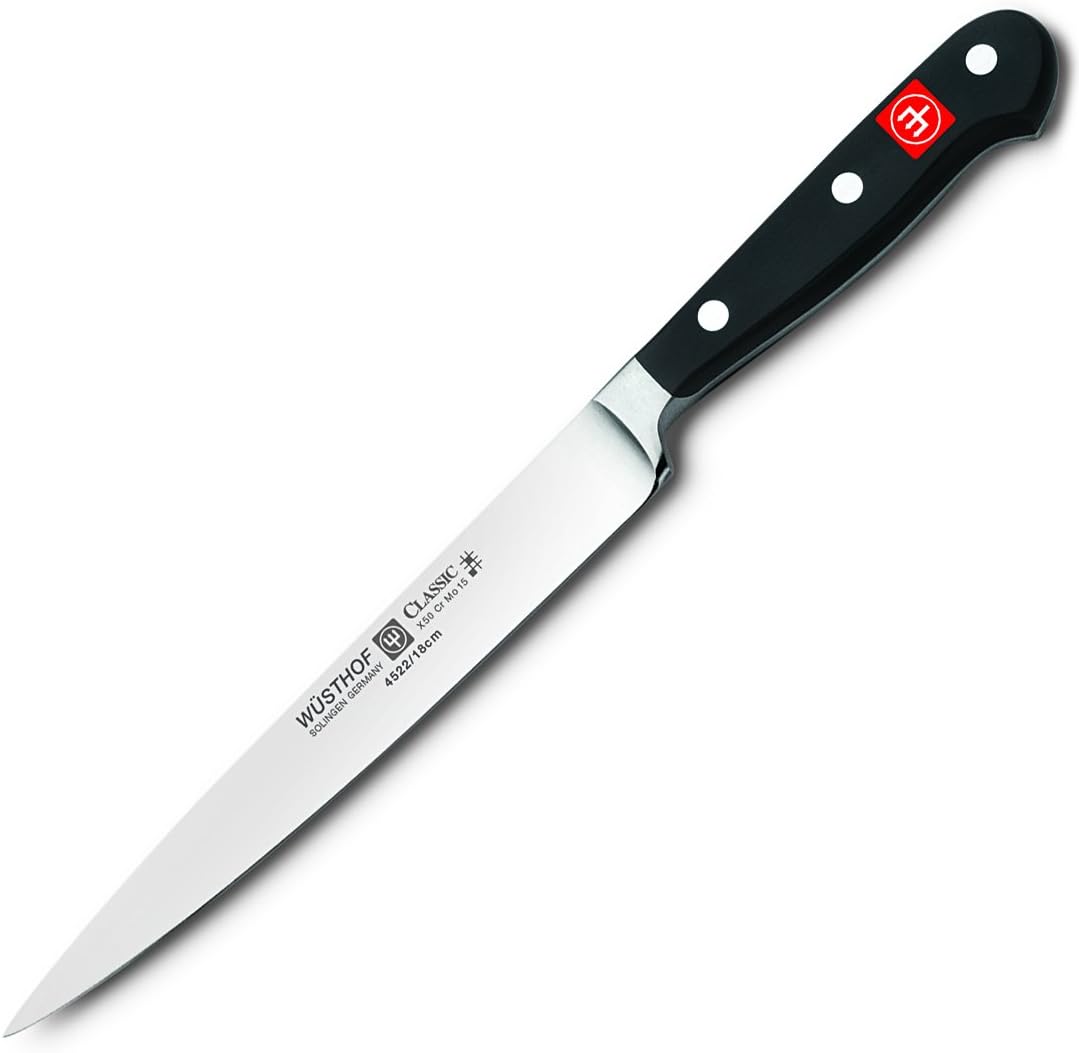 The Wüsthof Classic full bolster — the metal collar prevents hand slipping onto the blade edge
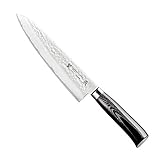 The Tamahagane 67-layer Damascus — each folded layer reduces blade-to-food friction