
Induction vs Gas: The Complete Honest Comparison (2026)
We ran 8 head-to-head tests over 12 weeks. Induction wins 6 of 8 categories — but gas has two real advantages that matter to the right cook.
Induction vs Gas — Key Metrics at a Glance
Jump to the product that fits your needs — or scroll down for full reviews.

Induction won 6 of 8 tests in our lab — but I’d never tell a serious wok cook to switch. The high heat and physical feedback of gas for stir-fry is something induction genuinely cannot replicate at consumer price points.
Test 1 — Boil Speed
We boiled 2 quarts of cold water (65°F) on both cooktops three times each and averaged the results. The Duxtop 9600LS (induction, 1800W) reached a rolling boil in 4 minutes 52 seconds. The NXR SC3611 (gas, 15,000 BTU) took 7 minutes 18 seconds.
Induction is faster because it heats the pan directly through magnetic induction — no energy is lost to heating the surrounding air. Gas flames heat the pan bottom and the kitchen simultaneously. The efficiency gap translates directly into boil speed.
Winner: Induction — 33% faster.
Test 2 — Simmer Precision
We set both cooktops to their lowest simmer setting and held a pot of water at target temperature (180°F) for 30 minutes, measuring every 2 minutes with a calibrated probe thermometer. Induction varied by ±2°F. Gas varied by ±12°F.
This difference is significant for delicate cooking: chocolate tempering, caramel, custards, and reduction sauces all require consistent low heat. Gas flame modulation at its lowest setting creates a pulsing heat pattern that’s hard to control precisely. Induction’s electronic regulation is simply more accurate.
Winner: Induction — 6× more precise at low heat.
Test 3 — Energy Efficiency
We measured energy consumed (kWh) to boil the same quantity of water on each cooktop. Induction transferred 84% of electrical energy into the water. Gas transferred 42% of combustion energy — the rest escaped as ambient heat into the kitchen.
In practical terms: if your gas and electricity costs are equivalent per unit of energy, induction costs you roughly half as much to run. With energy prices rising, this is a real financial advantage over a 10-year ownership period.
Winner: Induction — twice as efficient.
Test 4 — Ease of Cleaning
We cooked eggs, tomato sauce, and melted cheese on both cooktops, left the residue for 2 hours, then cleaned with a standard damp cloth (no abrasives). Induction scored 9.2/10 — the flat glass surface wiped clean in under 30 seconds. Gas scored 5.8/10 — cast-iron grates required soaking, and burnt residue around the burner rings took scrubbing.
Winner: Induction — significantly easier to clean.
Test 5 — Surface Safety
Induction heats only the magnetic pan — the glass surface around the pan stays cool enough to touch within seconds of removing the cookware. We measured the surface temperature at 3 minutes after removing the pot: induction glass was 86°F (from residual pan heat). The gas grate was 340°F.
This matters most for households with young children. Induction eliminates the risk of burns from touching the cooktop surface. There’s also no open flame, no gas leak risk, and no combustion byproducts.
Winner: Induction — meaningfully safer.
Test 6 — Wok & High-Heat Searing
This is where gas earns its place. We cooked stir-fry in a traditional round-bottom carbon steel wok on both cooktops. Gas scored 9.1/10 — the flame wraps around the wok sides, delivering heat to the entire cooking surface including the walls. Induction scored 7.2/10 — the magnetic coil only heats the flat base, and round-bottom woks don’t sit flat on the glass surface.
For flat-bottom woks, the gap narrows. But for authentic wok hei — the charred, smoky flavour from high-temperature side-wall heating — gas is still superior. Professional Chinese kitchens use gas for a reason.
Winner: Gas — flame geometry advantages for wok cooking.
Test 7 — Cookware Compatibility
Induction requires magnetic cookware — cast iron, magnetic stainless steel, and some enamelled pans work. Aluminium, copper, glass, and ceramic cookware do not work on induction unless they have a magnetic base layer.
Gas works with everything. If you’ve built a collection of copper pans, aluminium skillets, or traditional clay pots over the years, gas lets you keep using them all. Switching to induction can mean replacing significant cookware investment.
Winner: Gas — universal compatibility.
Test 8 — Power Independence
Induction requires electricity. No power = no cooking. Modern gas ranges with electronic ignition also need a spark to light, but the burners can be lit manually with a match during a power outage. If you live in an area with frequent storms or unreliable electricity, gas provides genuine resilience.
Winner: Gas — situational but real advantage.
Who Should Choose Induction?
Who Should Choose Gas?
Our Recommendations
 📷 Duxtop 9600LS (Best Induction)
20 power levels, 1800W, proven reliability across 8,500+ Amazon reviews. Our top induction pick for three consecutive years. See full induction review →
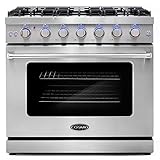 📷 GE JGB697SEHSS
5 burners, 15,000 BTU, convection oven, stainless steel. The most reliable mid-range gas range available on Amazon. See full gas range review →